As shipping costs continue to rise, many ecommerce brands are discovering that split shipments are quietly eroding margins. A split shipment occurs when a single customer order ships in two or more packages, often from different warehouses or at different times. Each additional package adds labor, packaging materials, and carrier charges, making fulfillment more expensive than many operators realize.
For most brands, learning how to reduce split shipments starts with improving inventory placement, refining order routing, and creating processes that allow more orders to ship complete from a single fulfillment node. While split shipments cannot be eliminated, reducing them can significantly lower per-order shipping costs and improve customer experience.
How Do You Reduce Split Shipments?
If you’re looking for the fastest path to split shipment reduction, focus on these five operational levers:
- Place high-volume SKUs in every fulfillment location.
- Use order routing optimization that prioritizes complete-order fulfillment.
- Set consolidation thresholds for backorders and pre-orders.
- Create kits and bundles for products commonly purchased together.
- Measure split rates monthly and identify root causes.
Many successful e-commerce brands maintain a split shipment rate below 5% to 8% of total orders. Reaching that level typically requires ongoing inventory and routing adjustments rather than a one-time project.
What Is a Split Shipment in E-commerce Fulfillment?
A split shipment definition is simple: a customer places one order, but the order is fulfilled through multiple packages. Each package receives its own tracking number and may originate from different fulfillment centers.
Split shipments happen for several reasons:
- Inventory Spread Across Multiple Warehouses: This is one of the most common causes: products within the same order are stored in different locations. If Warehouse A carries SKU 1 and Warehouse B carries SKU 2, the order may require two separate shipments.
- Out-of-Stock Situations: When the closest fulfillment node lacks inventory, an order management system (OMS) may source products from multiple facilities to complete the order.
- Backorders and Pre-Orders: When some products are immediately available, and others are delayed, brands often ship available items first and remaining products later.
- Special Handling Requirements. Hazmat, fragile, oversized, or temperature-sensitive items frequently require separate packaging and transportation methods.
- Routing Logic: Some systems allocate inventory by line item rather than evaluating the complete order. This often increases split shipment costs that e-commerce businesses experience every month.
- Marketplace Service-Level Agreement: Programs such as Amazon Seller Fulfilled Prime and TikTok Shop fulfillment can prioritize delivery speed over shipment consolidation, resulting in additional splits.
How Split Shipments Increase Per-Order Fulfillment Costs
Brands looking to reduce split shipments should focus on five key areas: inventory placement, order routing optimization, consolidation thresholds, kitting, and ongoing measurement. Split shipments occur when a single order ships in multiple packages, often due to inventory being spread across different warehouses, stock shortages, backorders, special handling requirements, or routing logic that prioritizes individual SKUs instead of complete orders.
By stocking high-velocity products across fulfillment nodes, optimizing routing rules, holding certain orders briefly for consolidation, and creating kits for products frequently purchased together, brands can reduce multi-package shipments and lower fulfillment costs. Tracking split shipment rates as a regular KPI is equally important, as many ecommerce businesses discover that split shipments quietly increase shipping expenses and impact customer experience. While some splits are unavoidable due to marketplace requirements or special handling needs, many DTC brands successfully maintain split rates below 5% to 8% through ongoing operational improvements.
Lever 1: Improve Inventory Placement Across Fulfillment Locations
Inventory placement is typically the most effective way to reduce multi-package shipments. The goal is straightforward: ensure products frequently ordered together are available in the same fulfillment location. Many operators create SKU velocity tiers:
- A-Tier SKUs: Top 20% of order volume stocked in every node
- B-Tier SKUs: Stocked in major fulfillment locations
- C-Tier SKUs: Long-tail inventory stored in fewer facilities
Historical order data can reveal which products are frequently purchased together. Once identified, those items should be positioned within the same fulfillment centers whenever possible.

Regular inventory rebalancing 3PL programs also help maintain optimal stock levels as demand patterns change throughout the year.
At Fulex, inventory placement strategies can be supported across a five-center network located in Detroit, Chattanooga, Grand Prairie, San Diego, and Delaware. This multi-node approach allows brands to position inventory closer to customers while minimizing unnecessary splits.
Lever 2: Use Order Routing Rules That Prioritize Complete Orders
Order routing optimization plays a major role in shipment consolidation.
Basic routing systems often prioritize the closest warehouse with available inventory for each individual SKU. While logical on the surface, this approach frequently creates split shipments.
More advanced routing strategies evaluate complete-order availability before making fulfillment decisions.
Single-Node Preference
The system first checks whether one fulfillment center can fulfill the entire order before considering multiple locations.
Zone-Aware Routing
Shipping zones multi-warehouse strategies evaluate both transit times and transportation costs to identify the most efficient fulfillment location.
Hybrid Routing Logic
Many brands adopt a balanced approach that favors consolidation while still supporting fast-delivery commitments.
Routing rules should be reviewed regularly. As product catalogs expand and order profiles change, fulfillment logic often requires adjustment to maintain efficiency.
Lever 3: Set Consolidation Thresholds for Backorders and Pre-Orders
Not every order needs to ship immediately.
Many fulfillment systems automatically separate available inventory from backordered products, creating guaranteed split shipments.
A better approach may involve consolidation thresholds.
For example, a brand might hold an order for 48 hours to determine whether incoming inventory can complete the shipment. If the delayed product arrives within the threshold window, the order ships as one package.
Some ecommerce brands also provide customers with options at checkout:
- Ship immediately in multiple packages
- Wait a few days for a consolidated shipment
- Receive an incentive such as free shipping or store credit
When expectations are clearly communicated, many customers willingly accept short delays in exchange for a simpler delivery experience.
Lever 4: Use Kitting and Bundling to Consolidate Frequently Purchased Products
Kitting is another highly effective method for brands looking to consolidate ecommerce orders. When products are frequently purchased together, warehouses can assemble them into a single SKU before orders are placed. Examples include:
- Starter kits
- Subscription boxes
- Promotional bundles
- Gift sets
Instead of picking multiple products separately, the warehouse processes a single item. This creates several benefits:
- One pick event
- One pack event
- One shipping label
- Fewer routing complications
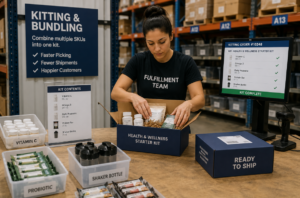
Most 3PL split shipment reduction initiatives include some level of kitting analysis because recurring bundle purchases often create opportunities for significant cost savings. As a family-owned 3PL with more than 23 years of experience supporting small and mid-sized businesses, Fulex offers kitting services that help brands simplify fulfillment while reducing operational complexity.
Lever 5: Track Split Shipment Rate as a Fulfillment KPI
You cannot improve what you do not measure. Every e-commerce operation should track split shipment performance as a standard KPI. A simple formula is:
Split Rate = Multi-Package Orders ÷ Total Orders
Next, categorize each split according to its cause:
- Inventory imbalance
- Backorders
- Special handling
- Routing logic
- Cutoff timing
This analysis reveals where operational improvements will generate the greatest return. Many brands target:
- Under 8% split rate = Healthy operation
- Under 5% split rate = Excellent performance
Monthly reviews involving both the brand and 3PL provider often produce the strongest results because each party has visibility into different parts of the fulfillment process.
When Split Shipments Are Actually the Right Call
While reducing split shipments is important, some are necessary. Orders may be split to meet fast delivery requirements, comply with carrier regulations for hazmat or oversized products, accommodate pre-orders, or reduce shipping costs through regional fulfillment. The goal is to eliminate avoidable splits caused by inventory or routing issues, not every split shipment.
Working With a 3PL on Split Shipment Reduction
A strong 3PL relationship can accelerate improvement efforts. Brands should ask their fulfillment partner for:
- Monthly split rate reporting
- Inventory placement analysis
- Routing rule reviews
- Kitting recommendations
- Inventory rebalance planning
The most successful optimization projects occur when both the brand and 3PL treat split reduction as a shared objective. With five fulfillment centers across the United States, Fulex helps brands evaluate inventory placement, routing strategies, and fulfillment workflows that support faster delivery while reducing avoidable split shipments and lowering per-order shipping costs.
Key Takeaways
Understanding how to reduce split shipments is one of the most practical ways to improve fulfillment profitability.
The five primary levers are:
- Inventory placement
- Order routing optimization
- Consolidation thresholds
- Kitting and bundling
- Ongoing measurement
Most ecommerce brands aim for a split shipment rate below 8%, with leading operators often achieving rates below 5%. Reducing splits is an ongoing operational process rather than a one-time initiative. Start by measuring your current split rate, identify the largest contributor, and focus improvement efforts there first.
How to Reduce Split Shipments FAQS
What causes split shipments in ecommerce?
Split shipments occur when inventory is spread across multiple warehouses, products are backordered, special handling requirements exist, or routing systems allocate items from different fulfillment locations.
How much does a split shipment really cost?
Split shipments often increase per-order shipping costs by 30% to 70% when additional labor, packaging, carrier labels, and dimensional weight charges are included.
What is a good split shipment rate?
Many DTC brands target a split rate below 8%, while operations under 5% are generally considered excellent.
Does inventory placement actually reduce splits?
Yes. Placing high-volume SKUs in every fulfillment node is typically the most effective way to reduce split shipments.
Should I always avoid split shipments?
No. Some split shipments are necessary for service-level agreements, special handling requirements, pre-orders, or regional fulfillment strategies.
Can a 3PL help me reduce splits?
Yes. Experienced 3PLs can support inventory placement, order routing optimization, kitting, inventory rebalancing, and ongoing split-rate analysis.