“Warehouse” and “fulfillment center” get used interchangeably, but they describe two fundamentally different operations. A warehouse stores inventory. A fulfillment center stores inventory and picks, packs, ships, and returns individual customer orders on your behalf.
For ecommerce brands, the distinction isn’t academic — it’s the difference between paying for static storage space and paying for an active operational partner that ships your orders, handles your returns, and connects to your store. Choosing the wrong one means either overpaying for services you don’t need or underbuilding the infrastructure your customers expect.
This guide breaks down what each one is, the six key operational differences between them, what each one costs, and how to decide which your ecommerce business actually needs.
Fulfillment Center vs. Warehouse: Quick Comparison
For brands that want the short answer up front:
| Factor | Warehouse | Fulfillment Center |
|---|---|---|
| Primary purpose | Long-term inventory storage | Active order fulfillment |
| Storage duration | Months to years | Days to weeks (ideally <30 days) |
| Operations | Static — receive, store, ship in bulk | Active — receive, store, pick, pack, ship, returns |
| Order types | Bulk B2B, pallet-level | Individual B2C orders + B2B + EDI |
| Shipping cadence | Scheduled LTL/FTL pickups | Daily parcel pickups, often multiple per day |
| Tech integration | Limited — typically standalone WMS | Integrated with ecommerce platforms via API |
| Best for | Manufacturers, importers, wholesalers | Ecommerce brands, omnichannel retailers, DTC |
| Cost structure | Long-term lease or per-pallet storage | Per-order pick/pack + storage + receiving |
The short answer: If you’re an ecommerce brand shipping individual orders to consumers, you need a fulfillment center. If you’re storing bulk inventory for distribution, retail wholesale, or future redistribution, a warehouse is enough.
What Is a Warehouse?
A warehouse is a building used to store goods — raw materials, finished products, or anything in between — before they’re sold, distributed, or moved to another location. Warehouses are used by manufacturers, importers, wholesalers, transportation companies, and retailers.
The defining characteristic of a warehouse is that it’s a static operation. Inventory comes in, gets stored, and goes out — usually in bulk, on pallets, via scheduled freight pickups. A warehouse doesn’t generally pick individual items off a shelf and pack them into a customized order for a single customer. It moves volume.
An “ecommerce warehouse” is just a warehouse that happens to store goods intended for online sale. The label describes the inventory, not the operation.
What Is a Fulfillment Center?
A fulfillment center is an active operational facility that stores inventory and processes individual customer orders end-to-end — receiving inventory, storing it, picking and packing each order, shipping it, and handling returns when they come back.
Fulfillment centers are operated by third-party logistics providers (3PLs) like Fulex. Ecommerce brands outsource fulfillment to them so they don’t have to build, staff, and run their own facility. The 3PL integrates directly with the brand’s ecommerce platform via API, receives orders automatically as customers place them, and ships them out within a few hours — typically with negotiated carrier rates the brand wouldn’t be able to access on their own.
A fulfillment center can act like a warehouse when needed, but a warehouse cannot act like a fulfillment center. The difference is the active layer of operations, technology, and services layered on top of the storage.
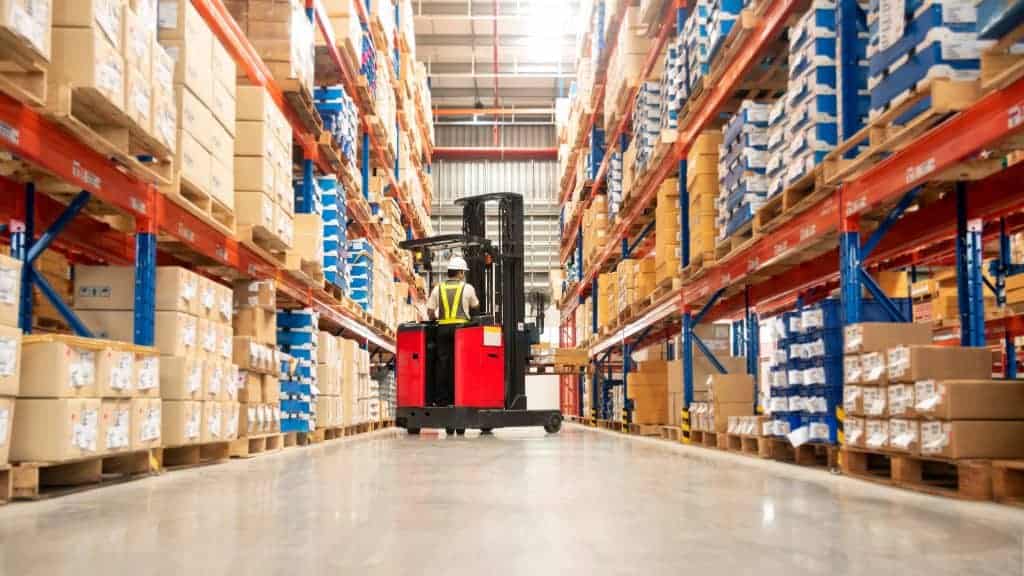
The 6 Key Differences Between Fulfillment Centers and Warehouses
1. Storage Duration: Long-Term vs. Short-Term
Warehouses are built for storage. Inventory often sits for months or even years, especially in distribution-focused operations or seasonal stock holding. Pricing reflects this — typically a flat per-pallet or per-square-foot rate over a long-term lease.
Fulfillment centers are built for velocity. The goal is to turn inventory over quickly, ideally within 30 days, so it doesn’t accumulate long-term storage fees. Most 3PLs charge a tiered storage fee that increases the longer inventory sits, which is intentional — slow inventory is expensive inventory.
2. Operations: Static vs. Active
In a warehouse, inventory comes in on pallets, sits on shelves or racks, and leaves on pallets. Forklifts move bulk. The operation is designed for storage efficiency.
In a fulfillment center, inventory comes in, gets put away in pick locations optimized for order velocity, and then gets touched repeatedly as individual orders trigger pick paths. Workers (or robotics) pick items off shelves, route them to packing stations, pack them in appropriate packaging, label them, and stage them for carrier pickup. The operation is designed for order throughput.
3. Shipping Carrier Relationships
Warehouses typically work with freight carriers — LTL (less-than-truckload) and FTL (full truckload) — for scheduled bulk pickups, often on a weekly or as-needed basis.
Fulfillment centers maintain daily parcel pickup schedules with multiple carriers: UPS, USPS, FedEx, DHL, and regional carriers. They rate-shop across carriers on every order to find the cheapest service that meets delivery time requirements, and they negotiate volume-based rates that small brands couldn’t access independently. Same-day and next-day cutoff times are typically built into the operation.
4. Inventory Turnover and Speed
A warehouse’s success metric is often utilization — how full is the space. A fulfillment center’s success metric is throughput — how many orders shipped, how accurately, how fast.
This shows up in everything: layout, labor model, technology stack, and cost structure. Fulfillment centers organize inventory by pick velocity (fast-movers near pack stations, slow-movers in overflow), while warehouses optimize for storage density. Same building footprint, completely different operational logic.
5. Services Offered
A warehouse stores. A fulfillment center stores plus does roughly a dozen other things, including:
- Receiving inventory and verifying against purchase orders
- Inventory management via warehouse management system (WMS)
- Pick, pack, and ship for individual orders
- Kitting and assembly for bundles and subscription boxes
- Returns processing and reverse logistics
- EDI compliance and routing guide adherence for big-box retailer shipments
- Amazon FBA prep and Seller Fulfilled Prime support
- Custom packaging and branded inserts
- Lot control and serial number tracking
- Carrier rate-shopping and label generation
For brands that need any of these services beyond pure storage, a fulfillment center is the only viable option.
6. Cost Structure
Warehouse costs tend to be fixed and predictable: lease or per-pallet rate, plus labor if you’re staffing it yourself. The economics work well when inventory sits and moves in bulk.
Fulfillment center costs are variable and scale with order activity: a per-order pick/pack fee, monthly storage by pallet or bin, receiving fees, packaging materials, and shipping at the 3PL’s negotiated rates. The economics work well when you’re shipping consistent volume and want costs to scale up and down with revenue.
When Does Your Ecommerce Business Need a Fulfillment Center?
The clearest signals that it’s time to move from self-fulfillment (or pure warehousing) to a fulfillment center:
- You’re shipping more than 50 to 100 orders per day consistently
- The founder or core team is spending more than 10 hours a week on packing and shipping
- Peak seasons become operational crises rather than growth opportunities
- You’re losing sales because shipping speed isn’t competitive
- Shipping costs are eating into margin because you’re shipping from a single location
- You’re expanding into wholesale, retail, or Amazon FBA and need B2B fulfillment capability alongside DTC
- You’re hiring people primarily to handle fulfillment instead of growth functions
Most ecommerce brands hit one or more of these signals between $1M and $10M in annual revenue, but the threshold depends heavily on product type, order size, and growth rate. For more on the operational and timing tradeoffs, see our guide to 3PL onboarding timelines and costs.
When Is a Warehouse the Right Choice?
A warehouse — without the active fulfillment layer — still makes sense in several scenarios:
- You’re a manufacturer, importer, or wholesaler moving bulk inventory rather than individual orders
- You hold long-term safety stock or seasonal inventory that doesn’t turn quickly
- You distribute exclusively to retail partners via LTL or FTL freight, not parcel
- You’ve built your own in-house fulfillment operation and only need overflow storage
- You’re staging inventory for redistribution to multiple fulfillment locations
Many growing brands actually need both: warehousing for bulk reserve inventory plus a fulfillment center for active selling inventory. Some 3PLs, including Fulex, can handle both within the same facility — meaning you don’t have to split inventory across separate vendors.
How Fulfillment Centers Handle Inventory Management and 2-Day Shipping
Inventory management inside a fulfillment center runs through a Warehouse Management System (WMS) that tracks every unit by location, lot number, expiration date (where relevant), and order history. When inventory arrives, it’s scanned in against the purchase order, assigned a pick location, and made available to ship within typically 24 to 72 hours of receipt.

When a customer places an order, the WMS receives the order data via API, generates a pick list, routes it to the appropriate warehouse worker (or pick robot), and tracks the order through packing, labeling, and carrier handoff. Tracking data flows back to the brand’s ecommerce platform and gets sent to the customer automatically.
For 2-day delivery — increasingly the baseline customer expectation — fulfillment centers solve the problem in two ways. First, by maintaining same-day shipping cutoffs (typically 12:00 to 2:00 PM local time) that get orders moving the day they’re placed. Second, by enabling brands to split inventory across multiple fulfillment center locations so customers are within 1 to 2 shipping zones of their order.
Fulex operates fulfillment centers in Chattanooga, TN, Dallas/Fort Worth, TX, Detroit, MI, New Castle, DE, and San Diego, CA — giving brands the ability to reach more than 95% of U.S. customers in 2 days or less by ground.
How Much Does Fulfillment Cost vs. Warehousing?
The cost comparison depends on what you’re including, but at a high level:
Self-fulfillment from your own warehouse typically runs $6 to $12 per order all-in once you account for labor, lease, supplies, software, insurance, and shipping at unnegotiated retail rates. Plus the founder time that doesn’t show up on a P&L.
Fulfillment center (3PL) fees typically include:
- Receiving: $25–$45 per pallet
- Storage: $15–$35 per pallet per month, or $0.50–$1.50 per bin per month
- Pick and pack: $2.50–$4.50 for the first item, $0.25–$0.75 for each additional item
- Packaging: included or $0.10–$0.50 per order depending on materials
- Shipping: at the 3PL’s negotiated carrier rates, typically 15–40% below retail
All-in, most ecommerce brands pay $4 to $8 per order through a 3PL — meaningfully less than self-fulfillment once volume scales, and with no fixed cost burden. See Fulex pricing for specifics.
Warehousing alone (without fulfillment services) typically runs $15–$30 per pallet per month, with minimal additional charges since there’s no active order processing.
The right comparison for most ecommerce brands isn’t warehouse vs. fulfillment center on storage cost — it’s the all-in cost of running your own fulfillment operation vs. outsourcing it to a 3PL.
How to Choose Between a Fulfillment Center and a Warehouse
Three questions clarify the decision:
- Are you shipping to individual consumers, or moving bulk inventory? Individual consumer orders means fulfillment center. Bulk-only means warehouse may be enough.
- Do you need integrated technology, returns handling, and active order processing? If yes, fulfillment center. If you only need storage and scheduled freight pickups, a warehouse works.
- How predictable is your volume, and how much fixed cost can you absorb? Fulfillment centers scale costs with order activity. Warehouses (especially self-operated ones) carry fixed cost regardless of volume — which makes them risky for businesses with seasonal swings or uncertain growth.
If the answer to question 1 is “individual consumers,” it almost always points to a fulfillment center. The other two questions help refine which fulfillment partner, location footprint, and service mix is right. For more on selecting the right partner, see our guide to 3PL partner selection.
The Right Choice Depends on What You’re Actually Doing
The warehouse vs. fulfillment center decision usually comes down to one question: are you storing inventory, or are you running an active ecommerce operation? Warehouses are for the former. Fulfillment centers are for the latter — and for most ecommerce brands, that’s the answer.
If you’re evaluating whether a fulfillment center makes sense for your business, or trying to figure out whether your current setup is the right one, request a custom quote from Fulex. We’ll walk through your current volume, locations, and pain points and show you exactly where a multi-location fulfillment partner fits.