Amazon fulfillment is entering a more demanding era in 2026 as Amazon raises operational expectations and reshapes how inventory moves through its network. Sellers who relied on simple FBA workflows now face stricter standards that affect speed, cost, and reliability across every stage of fulfillment.
For modern brands, Amazon fulfillment is no longer a background function. It has become a strategic system that influences margin, scalability, and customer experience. Understanding how Seller Fulfilled Prime, evolving FBA prep requirements, and scalable kitting programs interact is essential for staying competitive in an increasingly complex marketplace.
The State of Amazon Fulfillment in 2026
Amazon fulfillment in 2026 is defined by accountability and interconnected performance. Small breakdowns in inbound accuracy, carrier reliability, or inventory placement can quickly ripple into slower delivery promises and higher costs across a catalog.
Many brands are moving away from single-model fulfillment strategies. Instead, they are designing hybrid systems that combine FBA, Seller Fulfilled Prime, and third-party logistics to improve resilience and control.
This shift has transformed Amazon fulfillment into a continuous optimization process rather than a static operational setup. Teams that succeed treat fulfillment decisions as ongoing strategic choices rather than one-time infrastructure decisions.
Amazon SFP in 2026: Stricter Standards and Operational Expectations
Seller Fulfilled Prime continues to appeal to brands that want control over inventory, branding, and customer experience while still offering Prime delivery. However, the operational bar has risen sharply in recent years.
In 2026, sellers must meet tighter handling time thresholds, stronger carrier performance requirements, and faster exception resolution standards. Even minor declines in on-time delivery or tracking accuracy can threaten Prime eligibility.
As a result, many brands now treat Seller Fulfilled Prime as a disciplined operational program rather than a secondary alternative to FBA. Sustainable success requires structured workflows, predictable staffing, and reliable carrier partnerships.
FBA Prep Policy Changes Sellers Need to Know
FBA prep requirements have become more stringent as Amazon increases enforcement around labeling accuracy, packaging quality, and inbound shipment compliance. These changes are designed to reduce friction inside Amazon’s fulfillment centers and improve network efficiency.
For sellers, FBA prep is no longer a simple checklist. Errors in prep can lead to higher fees, delayed inventory availability, and amplified operational costs across the fulfillment lifecycle.
Brands that invest in standardized FBA prep workflows are better positioned to maintain predictable inbound performance, protect margins, and reduce volatility in day-to-day operations.

The Growing Role of Kitting and Assembly for Amazon Brands
Kitting and assembly have become strategic tools for differentiation and growth among Amazon brands. By bundling products into unique SKUs, brands can increase average order value and reduce direct price competition.
In 2026, kitting and assembly also support operational efficiency. Well-designed bundles can simplify inbound processes, improve shipping economics, and streamline FBA prep requirements across multiple product lines.
Brands that treat kitting as a scalable program rather than a one-off tactic are better equipped to adapt to changing marketplace dynamics and evolving customer expectations.
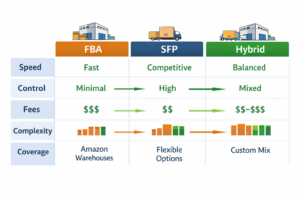
When to Use FBA vs SFP vs Hybrid Fulfillment
Choosing between FBA, Seller Fulfilled Prime, and hybrid fulfillment models depends on product characteristics, operational capabilities, and margin structures.
FBA often works best for standardized, high-velocity products with predictable demand. Seller Fulfilled Prime is more suitable for brands that require greater control over packaging, inventory allocation, or branding.
Hybrid fulfillment models allow sellers to combine the strengths of both approaches. By allocating SKUs strategically across fulfillment paths, brands can balance speed, cost efficiency, and operational flexibility more effectively.
Strategic Implications for Amazon Brands in 2026
The most competitive brands in 2026 treat Amazon fulfillment as a strategic capability rather than a logistical expense. They design integrated systems that align FBA, Seller Fulfilled Prime, and kitting programs within a unified operating model.
Fulex helps brands build scalable Amazon fulfillment systems that balance speed, cost control, and operational discipline. By supporting FBA prep, kitting and assembly, and Seller Fulfilled Prime workflows, Fulex enables sellers to navigate evolving requirements without sacrificing performance.
For brands reassessing their Amazon fulfillment strategy, Fulex can evaluate current operations, identify structural risks, and design a scalable model built for long-term growth and competitive advantage.