Understanding 3PL pricing models is one of the most important steps when evaluating fulfillment partners. While many providers offer similar services, their pricing structures can vary significantly. Without a clear understanding of how fees are calculated, brands may struggle to accurately forecast costs or compare providers. For growing e- commerce businesses, choosing the right pricing structure can have a direct impact on profitability, scalability, and customer experience.
What Are 3PL Pricing Models and How Do They Work?
3PL pricing models are the methods third-party logistics providers use to charge for warehousing, order fulfillment, inventory management, and related services. Some providers focus on transaction-based pricing, while others bundle services into monthly programs. Understanding these structures helps businesses evaluate total costs rather than focusing on a single fee category.
At Fulex, we work closely with small and mid-sized businesses to create transparent pricing that aligns with operational needs. As a family-owned company with over 23 years of experience and five fulfillment locations, we understand that pricing should support growth rather than create surprises.
Why 3PL Pricing Models Vary From One Provider to Another
Not all fulfillment operations are built the same. Differences in warehouse locations, technology platforms, labor requirements, service levels, and shipping volumes all influence 3PL pricing models. A provider handling high-volume standardized products may use a different approach than one supporting complex kitting, subscription boxes, or retail compliance programs.
Because every business has unique requirements, fulfillment pricing often reflects the operational complexity involved in processing orders accurately and efficiently. This is why comparing providers requires looking beyond headline rates.
How Per-Order Pricing Works in 3PL Fulfillment
One of the most common 3PL pricing models is per-order pricing. Under this structure, businesses pay a fee each time an order is processed and shipped. The fee typically covers receiving the order, processing it through the warehouse management system, and preparing it for shipment.
Many providers combine per-order pricing with additional charges based on the number of items included in each order. This approach works well for businesses with predictable order patterns because costs scale directly with sales volume. It also makes fulfillment pricing easier to forecast during periods of growth.
What Storage Fees Cover in 3PL Pricing Models
Warehousing inventory is another major component of 3PL pricing models. Most providers charge monthly storage fees based on the amount of space inventory occupies. This may be calculated by pallet position, shelf space, cubic footage, or bin location.
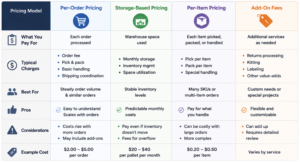
These storage fees cover warehouse space, inventory management systems, security, utilities, and ongoing inventory handling. Businesses should carefully review how storage fees are measured because methodologies can vary significantly between providers.
How Pick and Pack Charges Affect Total Fulfillment Cost
In many 3PL pricing models, labor-related activities are billed separately. The most common example is pick and pack services. Warehouse teams retrieve products from inventory, verify order accuracy, package items, and prepare shipments for carrier pickup.
Some providers include pick and pack activities within their standard order fees, while others charge separately for each item handled. These labor costs can become a meaningful part of overall fulfillment pricing, particularly for businesses with large orders or multiple SKUs.
Common 3PL Fees Beyond Storage and Order Fulfillment
Beyond storage and order processing, businesses should expect additional fees depending on service requirements. Common examples include receiving inventory, returns processing, kitting projects, labeling, account management, special packaging, and retail compliance preparation. These costs are not necessarily hidden fees, but they should be clearly outlined before signing an agreement. The most effective 3PL pricing models provide transparency around both standard services and value-added activities. This helps brands build realistic budgets and avoid unexpected expenses as operations scale.
3PL Pricing vs. In-House Fulfillment Costs: What Should Brands Compare?
Comparing 3PL pricing models against internal fulfillment operations requires looking at the full cost picture. Many businesses focus only on warehouse rent or labor expenses while overlooking technology investments, equipment, management overhead, insurance, recruiting, and training costs.
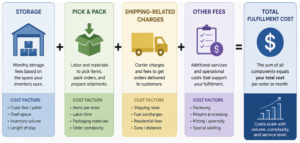
A comprehensive comparison often shows that outsourced fulfillment pricing can be more predictable than managing fulfillment internally. As order volume grows, businesses gain access to professional infrastructure and operational expertise without making large capital investments.
How to Compare 3PL Pricing Models Before Choosing a Provider
When evaluating providers, businesses should request complete pricing breakdowns, service-level expectations, reporting capabilities, and scalability information. Understanding how 3PL pricing models change as volume increases is especially important because growth can significantly impact total costs.
Brands should also ask how inventory is measured, how returns are processed, what support is included, and whether there are minimum monthly commitments. The best 3PL pricing models are not always the cheapest. Instead, they provide the right balance of service, flexibility, visibility, and long-term value. Before signing any fulfillment agreement, decision-makers should ensure pricing aligns with operational goals, growth projections, and customer expectations. For many e-commerce brands, partnering with an experienced provider like Fulex delivers the transparency and operational support needed to scale confidently while maintaining control over fulfillment pricing and overall logistics performance.
3PL Pricing Model FAQs
What are 3PL pricing models?
3PL pricing models are the structures logistics providers use to charge for warehousing, order fulfillment, inventory management, shipping support, and related services.
How do 3PLs charge for fulfillment?
Most providers charge through a combination of order processing fees, storage costs, receiving fees, and value-added service charges.
What is included in 3PL storage fees?
Storage fees typically cover warehouse space, inventory management, security, utilities, and inventory handling activities.
Do 3PLs charge per order or per item?
Many providers use order-based pricing combined with item-level charges, depending on the complexity of fulfillment operations.
How do I compare 3PL pricing models?
Compare total costs, service levels, technology capabilities, scalability, contract terms, and operational support rather than focusing solely on individual fees.