Shopify merchants often reach a point where packing boxes and managing shipping consume more time than growing the business. That’s where 3PL fulfillment for Shopify comes in. A third-party logistics (3PL) provider stores inventory, fulfills orders, and manages shipping on behalf of a merchant. Through a direct Shopify connection, orders flow automatically to the fulfillment center, and tracking information is sent back to customers without manual work.
For growing ecommerce brands, outsourcing fulfillment can improve efficiency, reduce shipping costs, and create more time to focus on sales, marketing, and customer experience. This guide explains how 3PL fulfillment for Shopify works, when it makes sense to outsource, what costs to expect, and how to choose the right fulfillment partner.
What Is a 3PL, and What Does It Do for a Shopify Store?
A 3PL handles the physical side of ecommerce operations. Instead of storing products in a garage, office, or self-managed warehouse, merchants send inventory to a fulfillment provider that manages storage and order fulfillment.
Typical Shopify fulfillment services include:
- Inventory storage
- Order picking and packing
- Shipping and carrier management
- Returns processing
- Inventory reporting
- Order tracking updates
Unlike dropshipping, a third-party logistics Shopify provider stores inventory that the merchant owns. It is also different from Shopify’s shipping label tools, which help generate labels but do not physically handle inventory or shipments.
Many providers also offer value-added services such as kitting, bundling, subscription box assembly, custom packaging, and Amazon FBA preparation.
How 3PL Fulfillment Works With Shopify, Step by Step
Understanding the workflow is essential when evaluating Shopify order fulfillment options. The process begins by connecting Shopify to the 3PL through an app, API, or direct integration, creating an automated link between the online store and the warehouse management system. Once connected, inventory is shipped to the fulfillment center, where products are received, inspected, and entered into the system for real-time tracking. When a customer places an order on Shopify, the order details automatically sync to the warehouse for fulfillment. The 3PL team then picks, packs, and ships the order using the most appropriate carrier service. After shipment, tracking information is sent back to Shopify and inventory levels are updated automatically, giving merchants complete visibility across all sales channels. Once the system is configured, most orders move through this workflow with little to no manual involvement.
How Shopify 3PL Integrations Sync Orders, Inventory, and Tracking
A reliable Shopify fulfillment integration is what makes outsourced fulfillment work efficiently. The integration automatically synchronizes:
- Orders
- Inventory levels
- Tracking numbers
- Fulfillment status
- Returns data
For brands selling on multiple channels, many providers support omnichannel fulfillment, allowing Shopify, Amazon, Walmart, and other orders to flow through the same inventory pool and dashboard.
Signs Your Shopify Store Is Ready for a 3PL
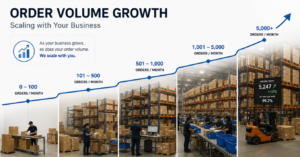
Most merchants begin exploring ecommerce fulfillment Shopify solutions when self-fulfillment starts limiting growth. As order volume increases, what once took an hour a day can quickly require an entire team to manage. Founders and key employees often find themselves spending valuable time packing orders instead of focusing on sales, marketing, and business growth.
At the same time, shipping errors, delayed orders, and inventory discrepancies can become more common, negatively affecting customer satisfaction. Customer expectations for fast one- to two-day delivery also make it more difficult and expensive to fulfill orders from a single location. Growing inventory can create storage challenges that exceed available space, while expanding into additional sales channels such as Amazon, online marketplaces, and wholesale accounts adds further operational complexity.
When these challenges begin impacting efficiency and scalability, partnering with a fulfillment provider often becomes the next logical step.
How Much Does 3PL Fulfillment Cost for Shopify Stores?
There is no universal Shopify 3PL cost because pricing varies based on factors such as product type, order volume, storage needs, and required services. Most fulfillment providers structure pricing around several core components. Receiving fees cover the unloading, inspection, and processing of incoming inventory, while storage fees are typically based on the amount of warehouse space used, whether measured by pallets, shelving, bins, or cubic footage. Pick-and-pack fees cover the labor involved in selecting products and preparing orders for shipment. Shipping costs are usually passed through directly from carriers, although many 3PLs can offer discounted carrier rates that smaller merchants may not be able to secure on their own, helping reduce overall fulfillment expenses.
Common Shopify 3PL Fees Beyond Storage and Pick-and-Pack c
Additional charges may apply for:
- Kitting
- Bundling
- Custom packaging
- Returns processing
- FBA preparation
- Special handling requirements
When evaluating providers, focus on total fulfillment cost per order rather than comparing only individual line items. A provider with slightly higher pick-and-pack fees may reduce overall shipping expenses through better warehouse locations and carrier discounts.
At Fulex, pricing is customized based on each merchant’s order profile, inventory requirements, and operational needs rather than relying on one-size-fits-all packages.
How to Choose the Best 3PL Provider for Shopify Fulfillment
Finding the best 3PL for Shopify requires looking beyond pricing alone. A strong fulfillment partner should offer a reliable Shopify integration that keeps orders, inventory, and tracking information synchronized in real time. Merchants should also evaluate warehouse locations, fulfillment accuracy, reporting capabilities, and scalability.
Key performance metrics to review include order accuracy rates, inventory accuracy rates, on-time shipping performance, and the provider’s ability to handle peak-season demand. Robust reporting tools provide visibility into inventory levels, shipments, and operational performance, while scalable systems ensure the provider can support future growth without major operational disruptions.
Businesses with unique requirements should also confirm whether the 3PL offers specialized services such as kitting, subscription box assembly, retail compliance, FDA-regulated handling, or Amazon FBA preparation. In addition, a smooth onboarding process and dedicated support team can significantly improve implementation success and reduce transition challenges.
Fulfillment center location is another critical factor because it directly affects delivery speed and shipping costs. The closer inventory is stored to customers, the faster and more cost-effective shipping becomes. Providers with multiple warehouse locations can reduce shipping zones and allow more orders to be delivered through affordable ground shipping methods. This is one reason many merchants choose nationwide fulfillment networks.
Fulex operates five strategically positioned fulfillment centers in California, Michigan, Tennessee, Texas, and Delaware, helping brands achieve one- to two-day ground shipping coverage across much of the United States while keeping transportation costs under control.
What Does Shopify 3PL Onboarding and Migration Involve?
Moving from self-fulfillment or another provider is typically a structured process.
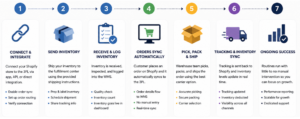
The onboarding process generally includes:
- Connecting Shopify to the warehouse system
- Configuring order routing rules
- Shipping inventory to the fulfillment center
- Receiving and validating inventory
- Running test orders
- Confirming tracking and inventory synchronization
- Establishing reporting preferences and reorder points
One common mistake is migrating during peak season or major promotions. Planning the transition during a stable period often reduces risk and simplifies troubleshooting.
A strong fulfillment provider will typically assign an onboarding specialist to guide the process and help ensure a smooth launch.
Pros and Cons of Using a 3PL for Shopify Fulfillment
Outsourcing fulfillment offers significant advantages, but merchants should understand the trade-offs.
Pros
- Faster shipping
- Improved order accuracy
- Access to discounted carrier rates
- More time for growth-focused activities
- Better scalability
- Multi-channel fulfillment support
- Reduced warehouse management responsibilities
Cons
- Less direct control over daily packing operations
- Ongoing fulfillment costs
- Dependence on a third-party partner
- Initial onboarding effort
For many growing stores, the operational efficiency and scalability benefits outweigh these challenges once order volume becomes consistent.
Key Takeaways
3PL fulfillment for Shopify allows merchants to outsource inventory storage, picking, packing, shipping, and returns while maintaining automated order synchronization through Shopify integrations.
Many businesses begin to outsource Shopify fulfillment when order volume increases, shipping complexity grows, or operational demands start limiting growth. Understanding fulfillment costs, integration capabilities, warehouse locations, and performance metrics can help merchants make informed decisions.
When evaluating providers, compare total fulfillment costs, shipping reach, technology capabilities, onboarding support, and operational performance. The right fulfillment partner should not only support current needs but also help create a scalable foundation for future growth.
Fulfillment for Shopify Stores FAQS:
What is 3PL fulfillment for a Shopify store?
A 3PL is a company that stores inventory and handles order fulfillment on behalf of Shopify merchants. Orders and tracking information synchronize automatically between Shopify and the
How does a 3PL integrate with Shopify?
Most providers connect through an app or API integration that automatically transfers orders, updates inventory, and sends tracking information back to Shopify.
How much does a 3PL cost for Shopify sellers?
Costs typically include receiving, storage, pick-and-pack, and shipping fees. Additional services such as kitting or returns processing may have separate charges.
When should I move my Shopify store to a 3PL?
Many merchants consider outsourcing when order volume, shipping demands, or fulfillment-related workload begins limiting growth and operational efficiency.
Is using a 3PL the same as dropshipping?
No. With a 3PL, the merchant owns the inventory stored at the fulfillment center. With dropshipping, products are shipped directly from a supplier.
Will a 3PL slow down my shipping?
In most cases, a well-positioned 3PL improves shipping speed by placing inventory closer to customers and leveraging discounted carrier networks.